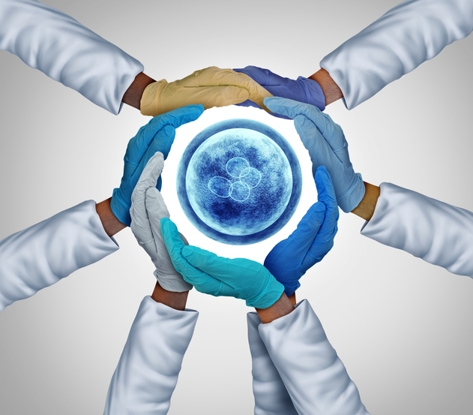
Can You Screen Embryos for Depression During IVF?
- Category: IVF, Preimplantation Genetic Testing, Preconception Testing
- Posted On:
- Written By: Palm Beach Fertility Center

Estimated Reading Time: 6 minutes
Table of Contents
- Why Depression Does Not Show Up on Embryo Testing
- What PGT-A and PGT-M Can Actually Find
- Why Mental Health Cannot Be Predicted at the Embryo Stage
- Ways to Support Your Well-Being Before Pregnancy
- How Palm Beach Fertility Center Supports Your Journey
People often imagine that genetic testing during IVF works like a window into the future. The idea that you can look at an embryo and understand everything about the life it might have is comforting. It creates a sense of control during a process that already feels uncertain.
So, it makes sense why many ask if depression or other mental health conditions can be detected in embryos. The honest answer is simpler and more human than most scientific explanations. It is not possible, and it is not because doctors do not care. It is because depression does not behave like the conditions that genetic testing is built to find.
Understanding why can ease fear, replace misconceptions with clarity, and help couples move through fertility care with realistic expectations instead of worry.
Why Depression Does Not Show Up on Embryo Testing
There is no single gene that causes depression. There is no clear mutation that predicts it. Most people who live with depression do so not because of one genetic switch but because of a combination of small genetic influences, environment, childhood experiences, hormonal changes, and moments in life that cannot be measured inside a lab.
Depression is shaped by hundreds of factors that interact quietly over years. This is why two people can share the same family history yet have very different emotional journeys.
Even the most advanced genetic panels cannot map out something this complex. Preimplantation genetic testing is designed for conditions with clear patterns. Depression is not one of them, and that does not mean your future child is destined to struggle. It simply means this part of human experience cannot be predicted in a Petri dish.
What PGT-A and PGT-M Can Actually Find
PGT-A and PGT-M are incredibly helpful in the right situations. They are tools with clear strengths that support healthier pregnancies, but they are often misunderstood.
PGT-A: Focused on Chromosome Health
PGT-A looks at whether an embryo has the correct number of chromosomes. Too many or too few can lead to miscarriages or certain genetic syndromes. This test helps identify embryos that are more likely to implant successfully.
What it cannot do is analyze emotions, personality, or mental health risk.
PGT-M: Built for Single-Gene Conditions
PGT-M is used when a specific, known genetic disorder runs in a family. It can test for conditions such as cystic fibrosis or Tay-Sachs because these have identifiable mutations.
Depression does not follow a single-gene pattern. There is no isolated marker for PGT-M to detect.
Understanding these limitations is not meant to discourage anyone. It is meant to provide reassurance that nothing about depression is being overlooked during IVF. The science simply does not exist to measure it.
Why Mental Health Cannot Be Predicted at the Embryo Stage
Some people hear about polygenic risk scores and believe these tools can predict depression. In reality, these scores are research concepts. They are not used in fertility clinics because they cannot reliably show who will or will not develop a mental health condition.
They cannot account for life events, relationships, resilience, family support, nutrition, therapy, childhood experiences, or the countless things that shape emotional health.
Mental health is not something that can be filtered out of embryos. It is something that is shaped over time and supported with compassion, awareness, and care.
Ways to Support Your Well-Being Before Pregnancy
Even though depression cannot be screened genetically, there are practical steps that make a real difference for parents who want to prepare.
- You can talk openly with your doctor about medication safety before pregnancy.
- You can build a support system early.
- You can plan for mental wellness the same way you plan for physical health.
- You can reduce fear by learning what truly influences future emotional well-being.
These steps are far more powerful than any test could be.
How Palm Beach Fertility Center Supports Your Journey
Palm Beach Fertility Center understands that family building is not just a medical process. It is an emotional one. While depression cannot be detected through embryo testing, our center offers a range of services that help parents start their journey with confidence and clarity.
Patients can access:
- Preconception carrier screening that identifies inherited genetic risks
- PGT-A and PGT-M for chromosomal and single-gene conditions
- Fertility evaluations for individuals and couples
- IVF, IUI, and personalized treatment plans
- Guidance from a compassionate team and our fertility specialists who understand both the science and the emotions behind this process
We provide care that respects your concerns and supports your choices. Even when certain outcomes cannot be predicted, you can still move forward with information, reassurance, and a team that walks beside you every step of the way.
If you are ready to explore your fertility options, our team is here to guide you with clarity that matches your goals and care that meets you where you are. Contact us at (888) 819-5177 to schedule a consultation and take the next step toward your family-building journey.